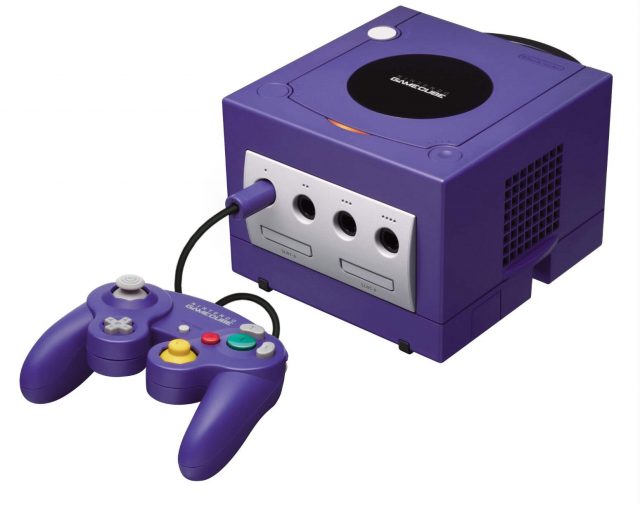
 As the predecessor to Wii, the GameCube was Nintendo’s worst selling console ever. During its six year life, it sold only 22 million units worldwide. Despite this, Nintendo reportedly turned a profit on the little purple box, thanks to a strong lineup of first party games and low cost hardware.
That said, I can’t help but wonder if Wii would have materialized had the GameCube operated at a loss. Would Nintendo have invested the necessary research and development costs on Wii had it not been for said profits? With access to enormous credit lines, they might have.
But the underwhelming success of GameCube coupled with its modest profits might have been just the thing to encourage Nintendo into rethinking its approach. What do you think? What if the GameCube was a complete bust? Would there even be a Wii? Perhaps something more desperate?
The less than stellar reception of the Gamecube probably helped push them to do something radical with their next console. (code-named Revolution anyone?) But Nintendo has always used smart business sense, turning a profit due to low cost hardware and high quality games. They've never had financial issues, so it's hard to imagine them failing dramatically. Sega failed as a hardware maker because their games weren't as revolutionary as Nintendo's have always been. This generation has been ridiculously profitable for Nintendo, so we can all rest assured they'll be around for a while.
No. What else would they have duck-taped together to make a Wii?
The real question is, what is Nintendo R&Ding now, with all of the gobs of cash they've been printing lately?
The humorous part is that Sony has somehow found a way to lose $3.5 billion dollars in the last 3 years on selling 60 million PSPs and 30 million PS3s, and several games.
For those wishing to be excited about Nintendo R&D, their budget for R&D last year (2008-2009) was in the range of $450 million. They forecast for the 2009-2010 a budget of ~$480 million. Even if, say $200 million of each years budget is game development (still not sure if it is game development, but even so, $200 million might still be a severe overestimation) That's still half a billion dollars spent over the past two years. Enticing and exciting to say the least.
Also of interest their capital investments surged from $86 billion in 2007-2008 to $306 million in 2008-2009. I'd imagine those are investments in third parties or startup companies and the like.
Microsoft is… well.. Microsoft. They've only been able to eke out a smallish yearly profit in the last few years, thanks to them writing down the Red Ring repairs and extended warranties all at once in 2007, where they lost $1.8 billion. But their entire involvement with video games has cost them somewhere between $8 and $9 billion. You think since they started all the price jacking they would have made more money by now.
They could take $1 billion and finance the 3DS, the Wii2, and every single game they will develop for each in their first 3 years, and still have money left over to "incentivize" a few third parties. Nintendo is getting quite mighty.
Wii came to life thanks more to the success of the DS rather than GC debacle. It showed Nintendo that innovation pays more than copycat. DS was cautiously presented and marketed as the third pillar in Nintendo's console portfolio, right along GBA and GC.
Then some time later (with Nintendogs and a renewed design) it became a dollar printing machine, crushing competition everywhere.
That probably spurred Nintendo to take the same route on the HC market, insted of going after the same road MS and Sony where going (thus clashing again in the same ol' market, where processing power is all that count), and choose to tackle on something revolutionary (project Revolution, aka Wii).
It paid off as well… maybe not as much as the DS (which is truly unstoppable), but enough to regain the lead, with a big margin, on the competitors and that alone is a big improvement over the last few generations.
Oh, and if GC wasn't going to make profits, GBA was probably more than enough to keep the company in the black as it sold more than 80 million devices.
@Jeff: I'd rather you be in a Michael Pachter position than Michael Pachter. Nice use of facts and fact-based analysis, seriously.
Nintendo R&D spending has been mentioned briefly before, in certain circles, but it really is impressive and ironically under the radar. Pretty exciting to see what all that dough will lead to. It also shows that they are still-forward thinking, and that the Wii and DS success hasn't softened them in the least.
3DS will surely be one of the first real examples of where their R&D spend has taken them.
Yes, I was just about to mention, the GBA was still immensly profitable at the same time, the Virtualboy was a far bigger flop, and the N64 was a 'disaster' for Nintendo before the Gamecube was. How did that affect their strategy?
Moreover, are we certain the Gamecube was comfortably profitable overall? Nintendo maintained high profitability fairly evenly over that period, but I don't remeber breakdowns of the profits between the GC and GBA segments. While Nintendo has never to my knowledge taken significant financial risk with their products, the GC was pretty technically advanced and yet inexpensively priced. It's a commonly held belief that Nintendo never sells systems at losses, but without breakdowns I think there's a good possibility the GC was sold at a minimal profit towards the end, and possibly a minimal loss at launch.
If the GameCube were even only minimally profitable let alone loss making, a poor return on investment coupled with the loss of sales and bigger loss of marketshare over two generations would mean Nintendo was facing the very connundrum Blake's talking about.
I suppose Nintendo's dependance on videogaming (Sony and MS had other options), combined with the impending threat of the PSP on their handheld business meant there was simply no way Nintendo could reasonably up and walk away from the console table.
Blake, You'll be hearing from my lawyers for blog post idea infringement.
Well, game development couldn't be more than 5-6 million per game, right? So the bulk of R&D has been going to the 3DS and the initial stages of Wii 2 development. Can't wait for E3!
The Gamecube is one of the most underrated systems of all time.
One of the most natural and intuitive controllers ever designed, if not The.
Great games with a fair amount of variety and innovation.
Good price point.
and YOU COULD GET AN ORANGE ONE.
Seriously though that D-pad was terrible. How did they manage to put literally the Exact Same D-pad as the GBA but somehow make it significantly worse?
The Gamecube didn't sell like gangbusters, no, but I thought it was a Nintendo policy that they never sold a system at a loss anyways?
I think that Nintendo would still have developed the Wii because they based the Wii's development on the success of the DS, NOT the gamecube. Besides that, I don't think the consoles success would have stopped them from developing it anyway (Virtual Boy anyone?)